Shikaku: rules, strategy, and free play
Shikaku (also called 'Divide by Squares' or 'Sikaku') is a grid-partitioning puzzle. Start with a grid sprinkled with numbered clue cells — your job is to divide the entire grid into rectangular regions, where each rectangle contains exactly one numbered cell and has an area equal to that number. The whole grid must be covered, with no overlap or leftover cells.
Free on Android · 100% ad-free · no sign-up →THE RULES
- Divide the grid into rectangles. Every cell on the board ends up inside exactly one rectangle — no overlaps, no uncovered cells.
- Each rectangle contains exactly one numbered clue. Rectangles without a number, or with two numbers, are illegal. The clue tells you the rectangle's area.
- Area = the clue value. A '6' means a rectangle of 6 cells — which could be 1×6, 2×3, 3×2, or 6×1. The shape that works depends on the clue's position and surrounding rectangles.
- Rectangles only — no L-shapes or non-rectangular regions. Every region must be a true rectangle (or square, which is a special case).
BEGINNER STRATEGY
- Solve prime-number clues first. A prime clue like 7 has only two rectangle options: 1×7 or 7×1 (see the reference table below). Even better, an edge-adjacent prime forces the direction — 7 in a cell three rows from the bottom can't be 7-tall and must be 1×7 horizontal.
- Use the edge constraint. A clue close to a grid edge limits rectangle dimensions in the constrained direction. A '12' in a cell only 3 rows from the top can only extend 3 cells UP — forcing at least 4 cells of width.
- Carve from opposite corners. When a clue has multiple rectangle options, check which configurations would conflict with neighbouring clues. If a 4 'wants' to extend right but a 6 is two cells right of it, the 4 must extend left or down instead.
- Sum check. The sum of all clues must equal the total grid area. As you place rectangles, the leftover cells must be coverable by the unplaced clues — if the remaining-area-needed doesn't match the remaining-clue-sum, you've made a mistake.
- Never guess. Shikaku has a unique solution by deduction. If you find yourself guessing, look for prime clues, edge-constrained clues, or conflicts between adjacent rectangle options that you haven't fully evaluated.
COMMON MISTAKES
- Forcing a rectangle before ruling out alternatives. When a clue has two or three possible rectangle shapes, beginners often place the first one that 'fits' without checking whether it blocks a neighbouring clue. Always check every neighbour before committing.
- Forgetting that rectangles must tile the whole grid. Every cell must be inside exactly one rectangle — there can be no leftover cells. Placing rectangles that leave isolated 1- or 2-cell gaps (with no matching clue) is an illegal configuration.
- Ignoring the edge constraint. A clue near the top-right corner can't extend both up AND right beyond the grid boundary. Edge proximity is often the strongest force on rectangle direction — use it first, not last.
- Placing large clues last. Large areas like 12 or 15 have fewer valid rectangle shapes than you'd expect once surrounding rectangles are placed. Solve large clues early — they constrain the geometry globally, while small clues constrain locally.
HOW TO THINK ABOUT IT
Shikaku is a geometry puzzle, not a number puzzle. The digits are constraints on shape, not values to place. Think of each clue as asking: 'given my position on the grid and the neighbouring rectangles, what rectangle dimensions can fit here?' Work from the most-constrained clues outward — primes, edge-adjacent clues, and large areas — and let the remaining cells fill naturally as valid rectangle options narrow to one.
WHY THIS PUZZLE REWARDS YOU
Shikaku is GridJoy's spatial-reasoning puzzle. Where Sudoku and Kakuro live in number-placement logic, Shikaku lives in geometry — every solution step is 'which rectangle dimensions fit here?'. The dual nature of the puzzle (every clue is both a position AND an area) makes the deduction feel different from other Latin-square / cage puzzles, and the visual carving as you place rectangles makes solving Shikaku oddly satisfying. Common grid sizes are 6×6 (easy) through 9×9 (hard).
RECTANGLE DIMENSIONS REFERENCE TABLE
Every clue value GridJoy's Shikaku uses, and every rectangle that can hold it on a board this size. A clue with one option is decided before you look at anything else. A clue whose only option is a 1×N strip has its shape decided too — all that is left is which way round it goes.
Grids run 6×6 to 9×9, so a shape's longer side is the smallest board it fits on. Where that is more than 6 the table says so — a 1×9 strip exists only on the 9×9.
| CLUE | RECTANGLE OPTIONS | NOTE |
|---|---|---|
| 1 | 1×1 | One cell - nothing to decide |
| 2 | 1×2 | Strip only - pick the orientation |
| 3 | 1×3 | Strip only - pick the orientation |
| 4 | 1×4 or 2×2 | |
| 5 | 1×5 | Strip only - pick the orientation |
| 6 | 1×6 or 2×3 | |
| 7 | 1×7 (7x7+) | Strip only - pick the orientation |
| 8 | 1×8 (8x8+) or 2×4 | |
| 9 | 1×9 (9x9+) or 3×3 | |
| 10 | 2×5 | Forced - only one shape fits |
| 11 | none | No rectangle of 11 cells fits a 9x9 board, so this clue never appears |
| 12 | 2×6 or 3×4 | |
| 13 | none | No rectangle of 13 cells fits a 9x9 board, so this clue never appears |
| 14 | 2×7 (7x7+) | Forced - only one shape fits |
| 15 | 3×5 | Forced - only one shape fits |
| 16 | 2×8 (8x8+) or 4×4 |
VARIANTS
- Fillomino. Divide the grid into regions where each region's size equals its digit. Unlike Shikaku's rectangles-only rule, Fillomino regions can be any contiguous shape — and some clue cells need no neighbours at all.
- LITS. Shade exactly one tetromino per outlined region so the shaded cells form a single connected group with no 2×2 block. Same region-partitioning intent as Shikaku but governed by tetromino shapes and connectivity rather than rectangles and area.
- Nurikabe. Shade cells to form one connected 'sea', leaving numbered islands of exactly the stated sizes. Structurally similar — each number anchors a region of fixed size — but islands can be any shape and the shaded sea's connectivity is the key constraint.
YOU MIGHT ALSO LIKE
Hitori →
Topology-heavy shading puzzle in a similar spatial family.
Hex Mazes →
Different spatial surface — paths through a hex grid.
Kakuro →
Number-side cousin if you want arithmetic instead of geometry.
How to play Shikaku (visual guide) →
Brand new? A real grid solved in pictures — the forced-rectangle trick, step by step.
How puzzle difficulty works →
What changes between Tier 1 and Tier 5 — pick your challenge level.
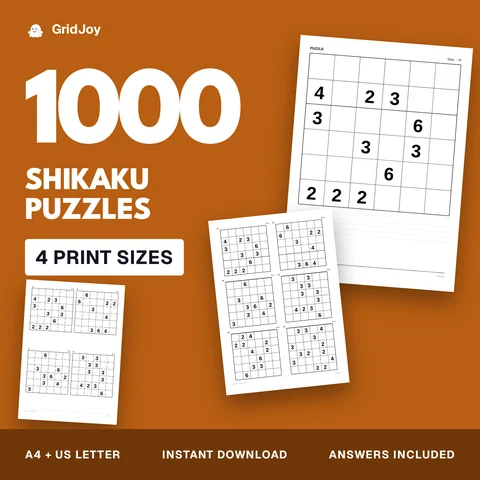 Print Shikaku at home →1000 puzzles as an instant-download PDF on Etsy — 4 print sizes, answers included, £2.99.
MORE NUMBER PUZZLES
Daily puzzle →
Today's free puzzle — same board for everyone.
Challenge a friend →
Same puzzle, head-to-head. Fastest wins.
Your ghost →
Grow your companion with every puzzle you solve.
PLAY IT IN GRIDJOY — FREE ON ANDROID
FREE ON GOOGLE PLAY →GridJoy has 18 puzzle types including Sudoku, Kakuro, Calcudoku, Killer Sudoku, Hex Mazes, and more. No paywalls, 100% ad-free.